
The Evolution of the Web and the Rise of Digital Assets

In 1991, the World Wide Web (WWW) revolutionized the internet by allowing developers to create web pages easily and enabling users to browse using links instead of command line interfaces. This era, known as Web1, featured centralized and permissioned networks like AOL and Prodigy. Over a decade, the maturation of web and HTML technologies led to more user-friendly websites, moving us beyond the rudimentary days of online billboards, thus giving birth to Web2.
Web2 brought about a more interactive and user-centric internet experience. However, the next evolution, Web3, is being shaped by the digital asset ecosystem, starting with cryptocurrencies, which are known as coins or tokens. Tokens in Web3 are analogous to websites in Web1; they are the fundamental building blocks of this new digital era.
As developers enhance these digital assets, they begin to function more like operating systems. Once these blockchain-based networks (operating systems) mature and support smart contracts, various applications can be built on them, spanning finance, consumer services, supply chains, identity management, and more.
The key difference in this technological cycle is decentralization. Unlike traditional operating systems owned by specific companies, these blockchain networks are decentralized. As a result, we are witnessing valuation increases not just in the tokens themselves but also in the surrounding infrastructure. This decentralization marks a significant shift in how value is created and distributed in the digital age.
To better understand the blockchain technological landscape, it's useful to categorize its components and services into distinct layers. This approach clarifies how different elements interact and highlights their specific roles within the blockchain environment. Let’s explore each layer, from foundational infrastructure to user-facing applications.
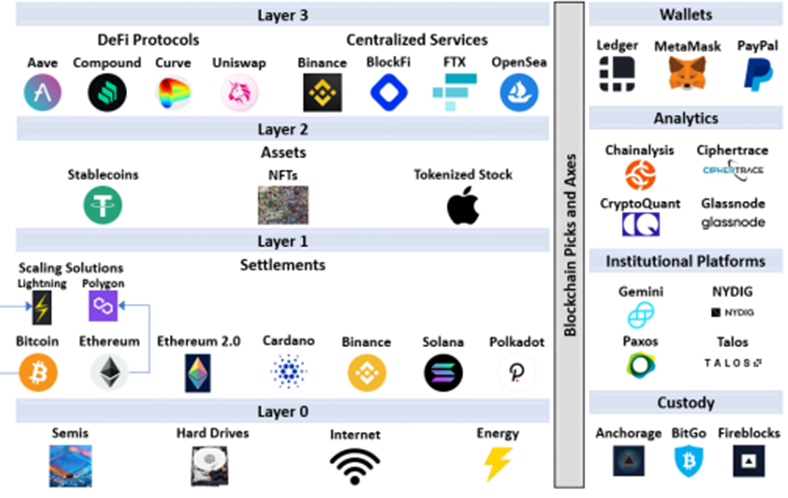
Layer 0: The Foundation of Blockchain Infrastructure
Semiconductors: The heart of computing hardware, semiconductors are critical for processing the vast amounts of data required in blockchain operations.
Hard Drives: Essential for data storage, hard drives retain the massive databases and transaction histories fundamental to blockchain technology.
Internet: The backbone of connectivity, the internet facilitates communication and data exchange across the globe, enabling decentralized networks to function.
Energy: The power source for all computing activities, energy is a crucial component, particularly for the energy-intensive processes of blockchain mining.
Layer 1: Settlements and Core Protocols
Bitcoin: The pioneer of cryptocurrencies, Bitcoin operates as a peer-to-peer network, providing a decentralized currency system.
Ethereum: Beyond just a cryptocurrency, Ethereum offers a platform for smart contracts, allowing developers to create decentralized applications (dApps).
Ethereum 2.0: The next iteration of Ethereum, focused on improving scalability, security, and sustainability through proof-of-stake consensus.
Cardano: A blockchain platform emphasizing sustainability, scalability, and interoperability, with a strong research-driven approach.
Binance: Known both as a cryptocurrency exchange and a blockchain platform, Binance supports a wide array of blockchain-based activities.
Solana: A high-performance blockchain designed for fast and secure decentralized applications and crypto-currencies.
Polkadot: A protocol enabling different blockchains to transfer messages and value in a trust-free fashion, aiming for a truly decentralized web.
Layer 2: Digital Assets and Value Representation
Stablecoins: Cryptocurrencies designed to minimize volatility by pegging their value to a stable asset, such as the US dollar (e.g., Tether).
NFTs (Non-Fungible Tokens): Unique digital assets representing ownership of a specific item or piece of content, making them ideal for digital art and collectibles.
Tokenized Stock: Digital tokens that represent shares of traditional stocks, bridging the gap between traditional financial markets and the blockchain (e.g., Apple).
Layer 3: Decentralized Finance and Centralized Services
DeFi Protocols: Platforms that offer financial services without intermediaries, leveraging the power of blockchain.
Aave: A decentralized lending protocol where users can lend and borrow cryptocurrencies.
Compound: Another platform for decentralized lending and borrowing, allowing users to earn interest on their crypto assets.
Curve: A decentralized exchange optimized for stablecoin trading, focusing on efficient swapping of similar-value assets.
Uniswap: A decentralized exchange protocol enabling automated token trading directly from liquidity pools.
Centralized Services: Traditional financial services adapted to the blockchain context.
Binance: Providing centralized exchange services alongside its blockchain platform.
BlockFi: Offering crypto-backed loans and interest-bearing accounts for digital assets.
FTX: A cryptocurrency derivatives exchange offering innovative trading products.
OpenSea: A marketplace for buying, selling, and discovering NFTs.
Blockchain Picks and Axes: Supporting Services
Wallets: Tools for securely storing and managing cryptocurrencies.
Ledger: A hardware wallet providing high-level security for digital assets.
MetaMask: A popular software wallet for Ethereum and ERC-20 tokens.
PayPal: Integrating cryptocurrency services into its well-established payment platform.
Analytics: Platforms providing insights and data analysis for blockchain activities.
Chainalysis: Offering blockchain analysis and compliance solutions.
Ciphertrace: Providing cryptocurrency intelligence and compliance tools.
CryptoQuant: Specializing in on-chain data analytics.
Glassnode: Delivering blockchain data and intelligence for market analysis.
Institutional Platforms: Services catering to institutional investors in the digital asset space.
Gemini: A regulated cryptocurrency exchange and custodian.
NYDIG: Focusing on Bitcoin financial services for institutions.
Paxos: Providing blockchain infrastructure and tokenization services.
Talos: Offering trading technology for institutional digital asset markets.
Custody: Ensuring secure storage of digital assets.
Anchorage: A digital asset platform with a focus on custody services.
BitGo: A digital asset trust company providing security solutions.
Fireblocks: Securing digital asset transfers with robust technology.
(Source: Source: Bank of America/JPMorgan)


Comments