
Understanding the Blockchain Trilemma

The blockchain trilemma, or scaling trilemma, is the idea that you can't fully optimize scalability, security, and decentralization all at once in a blockchain. Improving one of these aspects usually means having to compromise on one or both of the others.

For example, an app that needs to handle many secure transactions might have to give up some decentralization. Knowing how these three aspects interact is key to understanding the challenges blockchain developers face.
Scalability: This refers to a blockchain protocol’s ability to grow and handle an increasing number of transactions as adoption rises. Scalability is essential for blockchain ecosystems to compete with and surpass traditional systems. In simple terms, scalability is achieved when a blockchain can process transactions on multiple nodes (computers) simultaneously.
Decentralization: One of the core principles of blockchain technology, decentralization ensures that no single entity holds too much control over the network. True decentralization means that the network can run on simple consumer hardware, such as laptops. However, some protocols, like Solana, prioritize speed by optimizing for high-performance computers, which may reduce decentralization.
Security: Security in blockchain is achieved when a large portion of the network’s nodes can withstand attacks. A common type of attack is a 51% attack, where a single group gains control of more than half of the network’s nodes, potentially manipulating the blockchain for financial gain. For example, Bitcoin Gold experienced such an attack, resulting in the theft of $18 million worth of digital assets.
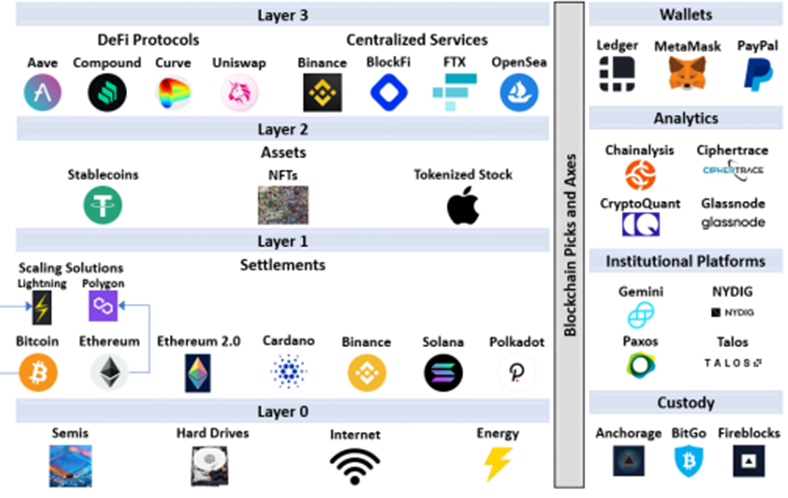
Solutions to solve the blockchain trilemma are emerging at both the Layer 1 (the base level of blockchain) and Layer 2 (built on top of existing blockchains).
Layer 1 Solutions (base level of blockchain): These involve improving the core blockchain itself. For example, Ethereum 2.0 is transitioning from Proof of Work (PoW) to Proof of Stake (PoS) to make the network more scalable and energy efficient. Another Layer 1 solution is sharding, which splits the blockchain into smaller parts (shards) that can process transactions simultaneously, greatly increasing the network's capacity. Ethereum 2.0 splits the Ethereum blockchain into 64 parallel chains that will work together to process transactions.
Layer 2 Solutions (built on top of existing blockchain): Layer 2 solutions build on top of existing blockchains to improve their performance. The Lightning Network for Bitcoin is a well-known example. It speeds up transactions and lowers costs by processing them off the main blockchain, though it compromises some decentralization. Polygon PoS is another Layer 2 solution for Ethereum. It scales the network by using side-chains that can handle up to 65,000 transactions per second (compared to Ethereum's 15 TPS) with much lower fees. However, using Polygon PoS requires learning a new platform, and its security is not as strong as Ethereum’s base layer.
(Source: Coinmarketcap, Swyftx)


Comments