
Salik: Toll Road

Updated: Mar 5
Salik operates Dubai’s electronic toll road system, launched by the Roads and Transport Authority (RTA) in 2007. The company listed on the Dubai Financial Market (SALIK.AE) in July 2022 and is majority owned by the government, which holds 75.1%, with 24.9% publicly traded.
Salik operates under a 49-year concession to run toll gates until 2071, with potential for extension. Importantly, road construction and maintenance are handled by Dubai’s RTA, while Salik focuses on operating the tolling system.
The company also carries investment-grade credit ratings (Moody’s A3, Fitch A-).
What Makes It Interesting?
Salik is interesting for a few reasons:
• Inflation-Hedged Returns: The company offers roughly 7% annual inflation-linked returns supported by Dubai’s long-term growth (4%+ GDP growth, 57% population growth by 2040, 13.9M international visitors, and 92.3M passengers through DXB, expected to rise toward ~250M after DWC airport expansion).
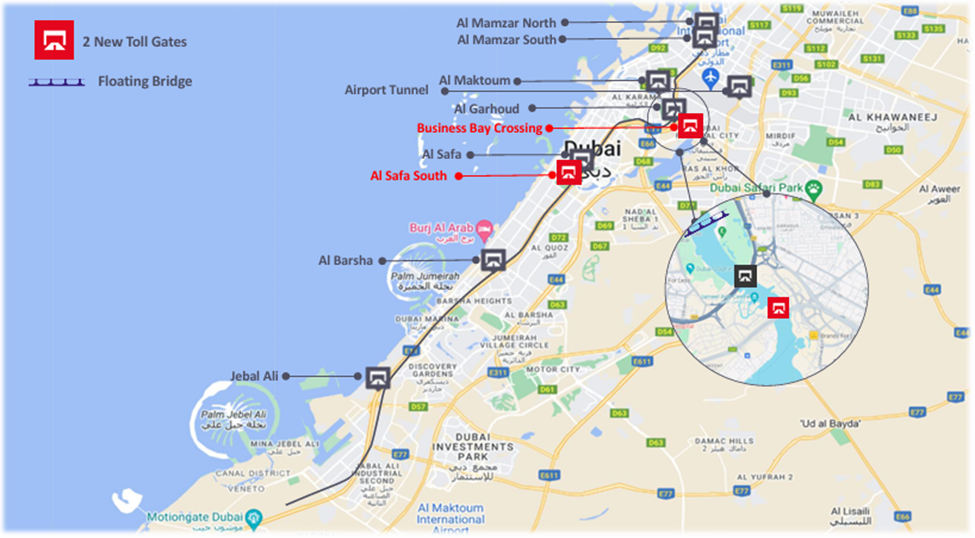
• Asset-Light Monopoly: Salik operates 10 toll gates across Dubai’s main roads and intersections, creating an unavoidable toll network and an effective monopoly. Unlike Toronto, where motorists can avoid the tolled 407 by using the un-tolled 401, Dubai’s key highway and bridges are all tolled leaving no practical alternatives.
• Contractual Downside Protection: Nationalization risk is limited by concession terms requiring the RTA (Dubai government) to compensate 130% of fair value plus termination costs if the concession ends early.
Read below for more insights.
Section 1: Background and History
Salik is Dubai’s electronic toll road system. It was launched by the Roads and Transport Authority (RTA) in July 2007 and became a publicly listed company in July 2022 on the Dubai Financial Market (DFM).
The company operates and maintains toll gates across Dubai and is responsible for designing and installing new toll gates and related tolling equipment. However, construction and maintenance of the actual road network remains the responsibility of the RTA.
Salik follows an asset-light model, focusing only on operating the tolling infrastructure. It currently maintains 10 toll gates, while road expansion and development are handled by the RTA. The company operates under a 49-year concession agreement with the RTA, running until June 2071. The concession began in July 2022 when Salik listed publicly; prior to that the business did not pay concession fees. The concession fee was reduced from 25% to 22.5% in April 2024.
Dubai currently has 4.7 million registered active vehicles (as of September 2025).
Salik started with two toll gates in 2007, expanded to eight by 2018, and today operates ten gates as of 2026. The company has over 18 years of operating history and maintains 100% exclusivity over tolling in Dubai.
In 2025, Salik was also included in the MSCI Emerging Markets Index.
Section 2: Business Model
Salik uses RFID technology that automatically deducts a fee when a vehicle passes under a toll gate. The system uses passive RFID tags, powered by the toll gate transceiver, meaning the tag itself requires no battery. Drivers receive an SMS when their balance runs low and can top up through the mobile app or website in under 30 seconds.
Motorists (all vehicles including taxis, except motorbikes) are charged once for a continuous journey. However, exiting the road network, re-entering, or passing another toll gate later is considered a new journey and charged again.
Salik has two main revenue streams:
• Tolling (~98%) – toll usage fees (86.9% of revenue) and fines (10.3%)
• Other revenue (~2%) – parking payment collection (Parkonic), advertising, data monetization, and insurance partnerships (Liva)

Section 3: Revenue / Geography / Unit Economics
Motorists must purchase a pre-paid Salik tag that is affixed to their windscreen. AED 4 (US$1.08) is deducted each time a vehicle passes through a toll gate. Salik currently operates only in Dubai, though the company is exploring expansion outside the UAE.
Variable pricing was introduced in January 2025, adding AED 60–110 million in annual revenue. Pricing now includes peak (AED 6), off-peak (AED 4), and past midnight (AED 0) tolls. For comparison, Toronto’s Highway 407 toll ranges from CAD $0.32 to $1.19 per km for cars.
Revenue growth is expected from new toll gates, variable pricing, additional services (parking, insurance, data monetization), and potential geographic expansion.
Salik’s cost structure is roughly 65-70% variable (concession fees, commissions, and tag costs) and 30-35% fixed costs.
Section 4: Market Size / Opportunity / Customers
Salik generates revenue from vehicle trips passing through its toll gates across Dubai.
The company is also expanding into pre-paid parking payments, allowing Salik accounts to be used in malls and parking areas, further monetizing overall car usage in Dubai.
There are 4.7 million registered Salik vehicles, growing at ~5.8% CAGR since 2022. Currently, 79.2% of all traffic flows through Salik gates, meaning most vehicle movement in Dubai already passes through the system.
This implies roughly ~80% of the total road traffic market is monetizable through Salik’s toll network.
Section 5: Competition
Salik operates as a monopoly. Unlike Toronto, where drivers can choose between the tolled Highway 407 and the non-tolled Highway 401 to travel east–west, Dubai’s system tolls major highways and bridges that connect the city, making the toll network largely unavoidable.
Other publicly listed global toll operators include Transurban (Australia) and Ferrovial (Spain). The latter includes a 6.8% stake in Canada's Highway 407 ETR.
Section 6: People / Ownership / Board
Chairman – H.E. Mattar Al Tayer: Chairman of the Roads and Transport Authority (RTA) since 2005. He has overseen AED 150+ billion of infrastructure projects, including the Dubai Metro, Dubai Tram, and Dubai Water Canal, and has been involved in Dubai’s urban master planning and rural development initiatives.
CEO – Ibrahim Al Haddad: Has 20+ years of experience in commercial transformation across multiple sectors. He joined the RTA in 2013, where he led the commercial and investment department before becoming CEO of Salik in 2022. Previous roles include Mubadala, Sama Dubai, and Dubai Municipality.
Salik is 75.1% owned by the Dubai government, with 24.9% publicly traded on the market.
Section 7: Finances / Valuation / Projection
Salik offers roughly ~7% inflation-linked returns, driven by a ~3% dividend yield and ~4% revenue growth (a proxy for dividend growth since ~100% of net income is distributed). This assumes steady growth over the long term.
Revenue growth is mainly driven by higher toll trips and demand-based pricing.
The company maintains a healthy balance sheet, with ~2.6x EBITDA leverage and a net debt covenant below 5x.
Salik distributes 100% of dividends twice per year.
Key metrics:
• Revenue growth: 4–6%
• EBITDA margin: 68–69%
• Net profit margin: 50–51%
• Dividend payout: ~100% of earnings

As of February 2026
Section 8: Competitive Advantage
Salik operates 10 toll gates today (up from 2 in 2007) across Dubai’s key roads and bridges, making it effectively the only way to move through much of the city’s road network.
The use of RFID technology allows vehicles to pass through toll gates without stopping, similar to Toronto’s Highway 407, which keeps traffic flowing and reduces congestion.
Section 9: Challenges / Risks
• Concession renewal risk: The current concession runs until 2071 (49 years remaining).
• Dividend payout sustainability: The company distributes ~90–100% of net income, leaving limited retained earnings.
• Nationalization risk: Salik is the listed operating company of the RTA, which owns 75% (with 25% publicly floated). The RTA itself is 100% owned by the Government of Dubai. If nationalized, the concession requires 130% of fair market value plus termination costs to be paid.
Section 10: Conclusion
Salik benefits from traffic-linked, inflation-protected revenues, with growth supported by rising mobility in Dubai (6.4% increase in public transport and taxi usage in 2024), variable pricing, and new ancillary revenue streams.
The company operates a capex-light model with high EBITDA margins and strong free cash flow conversion, supported by a conservative balance sheet that allows efficient debt servicing.
Its outlook is anchored in Dubai’s long-term growth at 4%+ GDP growth, 57% population growth by 2040, and rising tourism (92.3M passenger inflows in 2024, 13.9M international visitors, +5% YoY) all of which translate into higher traffic volumes.
The strategic placement of toll gates across key roads and bridges further reinforces Salik’s ability to capture this growth.
(Sources: Salik Investor Presentation, Financials)


Comments